
Retail inflation eased to an 11-month low of 4.83 per cent in April as prices of some kitchen items declined though overall food basket firmed up marginally, according to a government data released on Monday. The Consumer Price Index (CPI)-based retail inflation was 4.85 per cent in March. It was 4.7 per cent in April 2023.

Foreign investment in multi-brand retail could help ease the problem of high food prices, an issue on which the government is fighting a major political battle, research firm Crisil said.

The meeting assumes importance as prices of essential commodities continued to surge though the rate of price rise has come down in the recent weeks.

What is going to happen to our world when hundreds of millions more people cannot afford to feed themselves?

Let there be no doubt that Modi in these 24 years so far has reshaped politics and governance considerably, if not completely, asserts Nilanjan Mukhopadhyay, author, Narendra Modi: The Man, The Times.

'2025 is the year to build a portfolio for the future. Focus this year should be on valuations and visible growth.'

'The decision to supply free food grains is not an economically sound decision because the government will find it very difficult in future to charge anything for food grains.'
Experts said onion prices, which are seeing deflation, are also headed to high-inflation territory in the coming months.
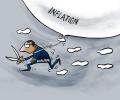
Wholesale price based inflation declined to a 3-month low of 1.89 per cent in November on cheaper food items, and experts predicted a 0.25 per cent interest rate cut by the RBI in the policy review in February. The Wholesale Price Index (WPI) based inflation was 2.36 per cent in October 2024. It was 0.39 per cent in November, last year. In August, 2024, it was 1.25 per cent.
The two crises are linked as, among the causes of rising prices, is the diversion of food crops for production of ethanol in an effort to cut down on consumption of oil. Referring to the expansion of the Security Council reform, Kerim conceded that sharp differences remain among the member States despite 14 years of discussions, pointing out that the only position on which all agree is that the current composition does not reflect the current realties.
Food prices fell for the second consecutive week as food inflation remained in the negative zone at (-)2.90 per cent for the week ended December 31, 2011.
While the world is better fed than it was 50 years ago, those gains are now under threat.

A United Nations expert body on Thursday said surge in food prices in India is a matter of concern, but retail price inflation will cool down to 7.5 per cent this year from around 12 per cent last year.

Geopolitical tensions, trade policy uncertainties, volatility in international commodity prices and financial market uncertainties pose considerable risks to India's economic growth in the coming year, the finance ministry cautioned on Wednesday. "Global trade continues to be affected by uncertainty in the policy environment... tariff-related developments in multiple countries have heightened trade-related risks, affecting investment and trade flows globally.
In a new report on Food Aid Flows, the World Food Programme says that food aid deliveries declined by 15 per cent in 2007, dropping to 5.9 million tons the lowest level since record keeping began in 1961. Wheat prices increased by 122 per cent and maize prices by 86 per cent between the years 2000 and 2007, according to the report, meaning that aid agencies had to reduce purchases of these commodities.
Finance Minister urged to work on alternative modes to lower inflation and help families save more

Virat Kohli faces SM ire over the price of bhutta served at his restaurant.
In its bi-annual report 'Food Outlook', FAO noted that much of the boost in cereal production took place in developed countries, where farmers were in a better position to respond to high prices. Concepcion Calpe, one of the main authors of the report, said this year's record cereal harvest and the recent fall in food prices should not create a false sense of security.

"This entire period is highly sensitive in terms of law and order, healthcare, sanitation, education, and disaster management. Hence, all related departments and district administrations must work with coordination and accountability," Adityanath said, according to an official statement.

'I wonder if they will keep it up after the elections.' 'I fear they'll start questioning eligibility -- income, age, bank accounts -- and eventually stop the scheme altogether.'

PMO being sent daily updates on food cost situation in four major metropolitan cities to ensure no unusual flare-up.

'Only a fool would put his life savings into a restaurant at 59... but I did'

'He has been one of the clearest thinkers in the history of business.'
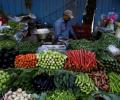
The wholesale price-based inflation declined to 4.95 per cent in December 2022, mainly due to fall in prices of food articles and crude petroleum. The Wholesale Price Index (WPI)-based inflation was 5.85 per cent in November 2022 and 14.27 per cent in December 2021. Inflation in food articles was (-)1.25 per cent, while in fuel and power it was 18.09 per cent during December 2022.

Whether it's navigating the labyrinthine Cu Chi Tunnels, boating on the Mekong, marveling at ancient Champa temples, or the Mekong Bay, Vietnam promises a journey like no other.
Exogenous shocks like rising global fuel prices and bad weather can start feeding into the general price level, if food prices rise sufficiently for labour to demand higher wages.

Even as the high inflation figure for October has ruled out any possibility of a rate cut by the Reserve Bank of India's (RBI's) monetary policy committee (MPC) in December, a rate cut in February also looks uncertain due to global uncertainties. Economists told Business Standard that unless domestic growth slows markedly, the outlook on rate cut remains unclear. India's headline inflation touched a 14-month high of 6.2 per cent in October, breaching the MPC's upper tolerance band of 6 per cent.

From the 30 Sensex pack, State Bank of India, Mahindra & Mahindra, Bharti Airtel, Titan, HDFC Bank, IndusInd Bank, Axis Bank and Bajaj Finance were the biggest laggards. JSW Steel, Tech Mahindra, Larsen & Toubro, Hindustan Unilever, HCL Technologies and Reliance Industries were among the gainers from the pack.
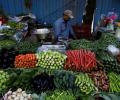
Retail inflation softened to 6.71 per cent in July due to moderation in food prices but remained above the Reserve Bank's comfort level of 6 per cent for the seventh consecutive month. With retail inflation continuing to remain high despite a fall in prices of vegetables and edible oils, among other commodities in July, the Reserve Bank of India (RBI) might go for another rate hike in September. The Consumer Price Index (CPI) based retail inflation was at 7.01 per cent in June and 5.59 per cent in July 2021. It was above 7 per cent from April to June this fiscal.

Deputy Governor Michael Patra warned about the spillover effects of food inflation.
S&P Global Ratings on Tuesday cut India's GDP growth projections to 6.5 per cent for the next fiscal as it expects that economies in the APAC region will feel the strain of rising US tariffs and pushback on globalisation. In its Economic Outlook for Asia-Pacific (APAC), S&P said despite these external strains, it expects domestic demand momentum to remain solid in most emerging-market economies.

After falling 17 per cent since the start of the year to its March lows, the stock of the country's largest pharmaceutical (pharma) company, Sun Pharmaceutical Industries, has clawed back nearly half of those losses. Recent acquisitions, a favourable court ruling in the case of the hair loss drug Leqselvi, an edge over peers owing to its specialty portfolio, and a diversified global presence have supported the recovery.
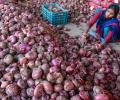
The Reserve Bank of India on Thursday raised its inflation projection to 5.1-4.7 per cent for the second half of the current fiscal on the back of spike in prices of vegetables such as onion and tomatoes.

As food inflation spurted to a six-month high, Singh said the immediate challenge before the country is how to sustain a high growth path, while keeping inflation in check.
Prices of agricultural commodities have risen 23 per cent so far this month.

The CPI, based on retail prices, stood at 113.9 points in December compared to 114.4 points in November, as per data released by the government on Wednesday.
"Oil prices are not going to come down. The era of cheap food is over and prices are likely to remain high for at least the next 10 years," World Bank South Asia Region Vice-President Praful Patel told PTI. He said the current situation has 'caught the whole world by surprise' and the crisis was due to a combination of factors, he said.

The agreement has ended a wartime standoff that had threatened food security in several countries and cleared the way for exporting tons of Ukrainian grains.
Food inflation rose marginally to 11.49 per cent for the week ended February 12 from 11.05 per cent in the previous week, driven by rising prices of milk, egg, meat and vegetables.

'I always cook from my heart,' says New York Chef Vijaya Kumar who won his third Michelin Star recently.
